

Do Chimpanzees Think Rationally? Yes
At a chimpanzee sanctuary in Uganda, researchers made a remarkable finding: chimps possess human-level rationality.

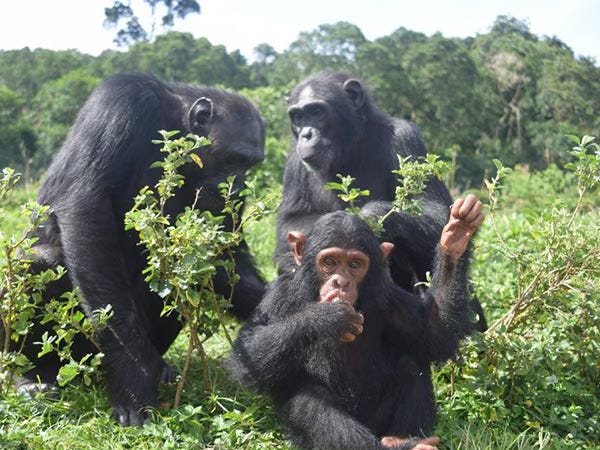
They say only humans can admit when they’re wrong. Chimpanzees might beg to differ. A new study finds that our closest relatives can rethink their choices and update their beliefs when better evidence comes along–just like us.
The study published in Science reports that chimpanzees “rationally revise their beliefs,” showing a kind of reflective intelligence once thought unique to humans. The paper’s authors write that “the selective revision of beliefs in light of new evidence has been considered one of the hallmarks of human-level rationality,” yet their experiments reveal that our primate cousins can do it too.
The research team designed a series of deceptively simple games and tested them at a chimpanzee sanctuary in Uganda. A chimp would watch food being hidden in one of two boxes, then receive clues–sometimes seeing the food directly (a strong clue), sometimes merely hearing a noise from inside (a weak one).
How did the chimps respond? They always went for the location where the evidence was stronger. If later clues suggested the food was in the other box, the chimp often switched. When the follow-up clue was weaker, the chimp stayed put.
“Chimpanzees responded to counterevidence in ways predicted by a formal model of rational belief revision: they remained committed to their initial belief when the evidence supporting the alternative belief was weaker, but they revised their initial belief when the supporting evidence was stronger.”
The scientists wanted to know whether chimps were just reacting to the most obvious cues or actually weighing them. In one follow-up, they gave chimps three boxes: one with strong evidence, one with weak evidence, and one with none.
When the strongest-evidence box was removed, the apes still favored the weak-evidence box over the one with no clues. The authors note that “chimpanzees indeed represented both options... suggesting that weaker representations are maintained even when the evidence supporting them is not the most salient.”
In another test, the animals distinguished between truly new evidence and mere repetition. “Chimpanzees demonstrated a significantly higher tendency to revise their initial choice in the ‘new evidence’ condition compared with the ‘redundant evidence’ condition.” They seemed to know when a fresh fact actually added information.
Finally, the team offered “evidence about evidence.” When a chimp saw food through a window and later learned the “food” was only a picture, it quickly abandoned its earlier belief.
The researchers interpret these behaviors as a sign of metacognition–thinking about one’s own thoughts. “Chimpanzees metacognitively evaluate conflicting pieces of evidence within a reflective process.” Even without language, the animals appear to grasp not only what they know, but how they know it.
“Thus, our findings present strong support for the view that chimpanzees have genuine metacognitive capacities,” the authors conclude.
For decades, scientists assumed that only humans could reflect on their own reasoning. This study blurs that boundary. If chimpanzees can weigh evidence, doubt themselves, and change their minds, then the roots of human-style rationality may reach much deeper into the evolutionary past than we ever imagined.
IMAGE OF THE WEEK
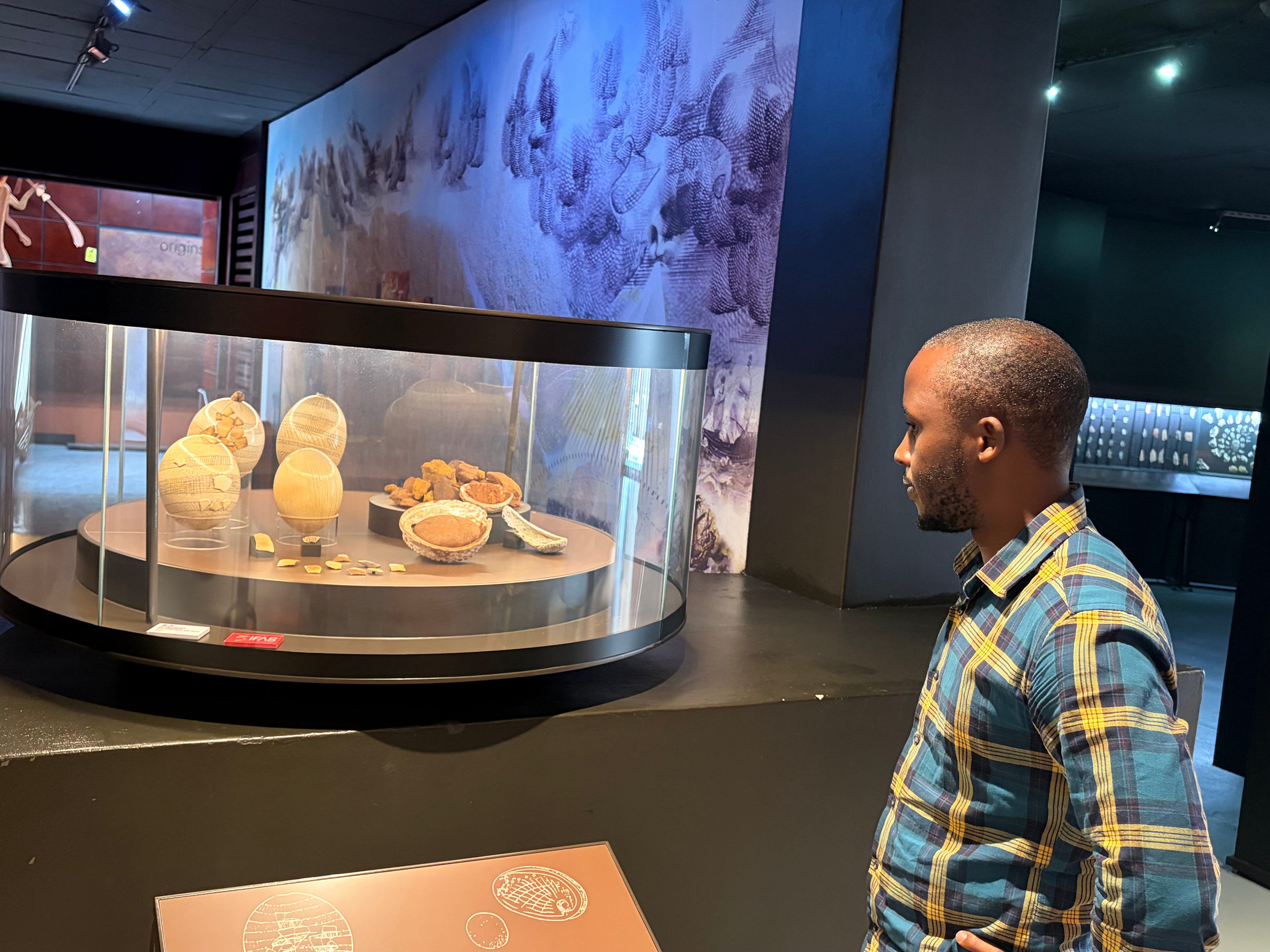
While in at Wits University last week, I visited Origins Centre Museum. In the photo, I am looking at engraved ostrich shells which are estimated to be between 100,000 and 60,000 years old that were used to carry water. They were found at Middle Stone Age sites in South Africa.
QUOTE OF THE WEEK
“The Congo Basin absorbs net about 600 million tons of carbon dioxide a year. That figure makes it the most carbon beneficial rainforest in the world. But data shows that figure has been coming down in recent years largely due to badly managed deforestation,” Executive Summary of Science Panel for the Congo Basin: 2025 Assessment Report. The full report will be out early next year.
RESEARCH HIGHLIGHTS
How Early Humans Adapted to a Changing World: Archaeologists have discovered that some of the earliest human ancestors thrived in East Africa during dramatic climate shifts more than 2.5 million years ago. Excavations at a newly found site called Namorotukunan in Kenya’s Turkana Basin uncovered thousands of stone tools dating from 2.75 to 2.44 million years ago–the earliest known evidence of Oldowan technology in the region. Despite major swings between wet and dry conditions, early humans consistently made sharp-edged tools from carefully chosen stone, showing skill and adaptability. These tools were likely used for cutting meat and processing plants, helping hominins survive as grasslands spread and water became scarce. The findings suggest that early technological innovation–the birth of toolmaking–evolved hand-in-hand with climate change, laying the groundwork for humanity’s rise. [Reference, Nature]
Climate Change Threatens Central Africa’s Food Crops by 2030. Climate change could sharply disrupt food production across Central Africa by 2030. Using machine learning models, researchers found that rising temperatures, shifting rainfall, and lower humidity will hit key crops—especially millet, sorghum, and groundnuts—while maize appears the most resilient. Northern areas like Chad and the Central African Republic could see falling yields due to heat and drought, while southern nations such as Burundi and Cameroon may experience modest gains. The models show strong regional contrasts, underscoring the need for country-specific adaptation plans. Scientists say these results highlight both the potential of advanced modeling tools and the urgency of preparing farmers for harsher growing conditions in the coming decade. [Reference, Meteorological Applications]
Why Oral Cancer Is Often Found Too Late in Africa: A review of studies from six African countries found that many people with oral cancer face serious barriers to getting diagnosed and treated early. Common problems include limited awareness of symptoms, reliance on traditional medicine, financial hardship, and poor access to healthcare facilities. Hospitals often have long waiting times, weak referral systems, and shortages of staff, equipment, and medication. People in rural areas and those with little education are especially affected. Fear of treatment, difficulty taking time off work, and gender-related issues also delay care. The study highlights the need for better public education, stronger health systems, and region-specific solutions to ensure earlier diagnosis and fairer access to treatment across Africa. [Reference, BMC Oral Health
—END—